Ouaddai is a region that geography has placed at the crossroads of worlds — Saharan, Sahelian, Sudanese and Arab. Its contemporary marginalisation is a transitional state, not a structural fatality. This analysis covers economic geography, commercial history, productive sectors, regional geopolitics, infrastructure, human capital and strategic vision, complemented by a module on creating an Islamic bank with Ouaddaian shareholders.
The analysis takes place in the context of an unprecedented triple convergence: the national Chad Connexion 2030 plan ($30B mobilised, $20.5B committed), the construction of the Abeche-Amdjarass road, and the spectacular rise in antimony (+300%) and gum arabic (+67%) prices. This window is unique and time-limited.
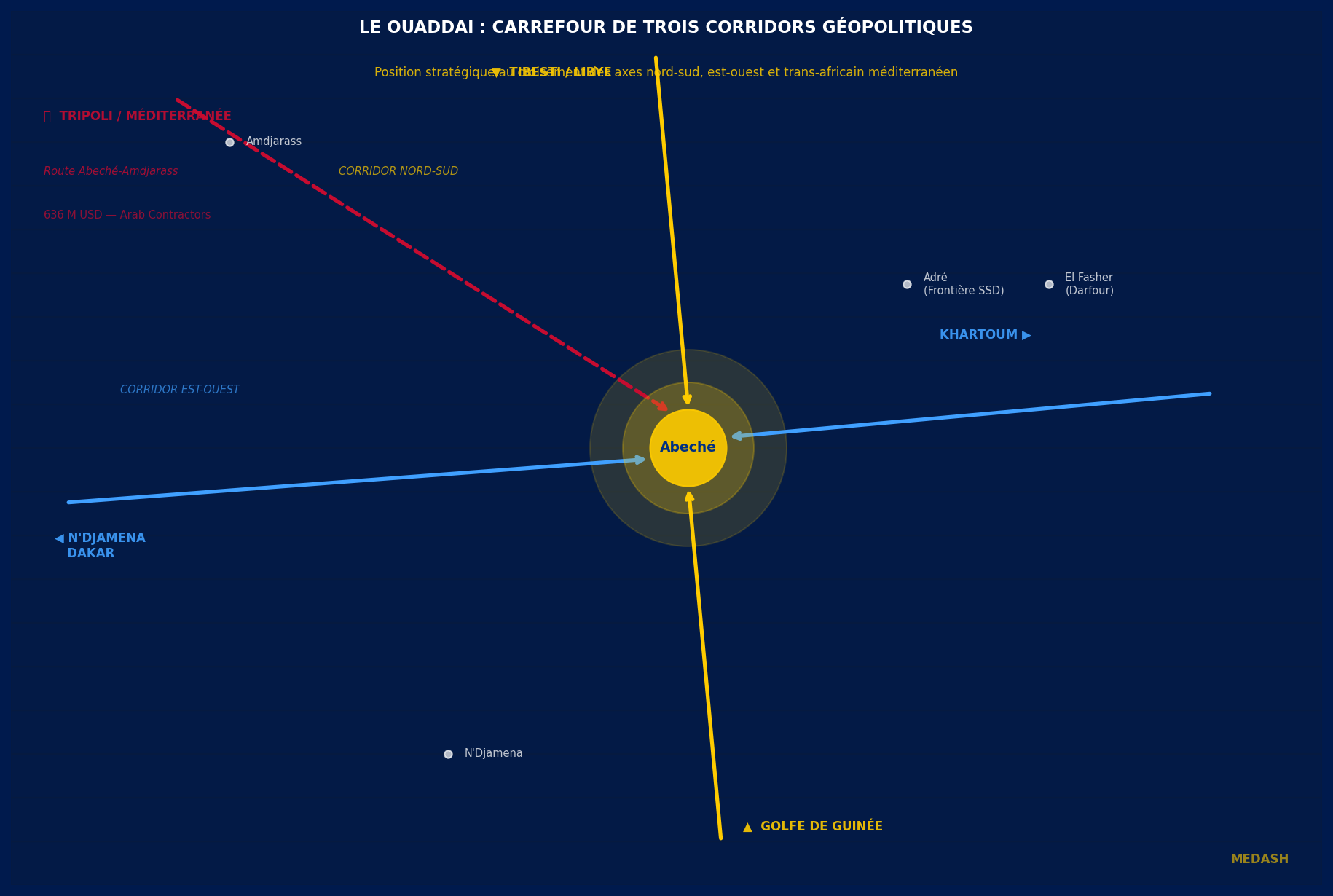
Ouaddai at the intersection of three major geopolitical corridors: north-south, east-west, and trans-African Mediterranean. MEDASH illustration 2026.
Economic Geography and Natural Resources
Geography is not destiny, but it shapes the space of possibilities.
1.1 Position and agro-ecological zoning
Ouaddai covers some 76,000 km² in eastern Chad, bordering Sudan, flanked by Wadi Fira to the north, Salamat to the south and Batha to the west. The regional capital Abeche — 900 km from N'Djamena — concentrates an estimated population of 900,000 to 1.2 million inhabitants. Its position is not peripheral: it is the crossroads of three major geopolitical corridors — north-south (Tibesti–Abeche–Central Africa), east-west (Khartoum–N'Djamena–Sahel), and the emerging trans-African Mediterranean corridor.
The territory is divided into three agro-ecological zones: the sub-desert zone (under 200mm), domain of camel herding; the central Sahelian zone (200–500mm), which concentrates the population; and the southern Sudanian zone (500–800mm), offering the best conditions for agricultural diversification.
1.2 The wadis: natural water infrastructure
The wadis — dry valleys with temporary flows — form the backbone of agricultural potential. The Batha, Am Zoer and Haraze wadis represent an estimated irrigable potential of 15,000–20,000 additional hectares, almost entirely unexploited. The advent of the submersible solar pump is a technological breakthrough: for the first time, wadi irrigation becomes economically viable without connection to the power grid.
High-value crops suited to these areas include long onion (price multiplied 3–4x in the dry season), sesame (strong Asian demand), and dates in arid zones. An extension of 5,000 irrigated hectares represents an investment of $7.5–15M, fundable through IFAD and the World Bank.
1.3 Mineral resources and transit economy
Antimony has seen a spectacular explosion: its price tripled since 2022, reaching approximately $38,000 per tonne (December 2024), after China reduced its exports of this strategic metal. The real profitability would come from a trading and certification zone in Abeche, transforming the city from a transit point into a marketplace.
1.4 Gum arabic: the green gold of the Sahel
Chad is the world's second-largest producer of gum arabic (30,000–50,000 t/year). The war in Sudan has disrupted 60% of global supply, pushing prices from $1,800 to over $3,000 per tonne (+67%). Yet 95–100% of Chadian production is exported raw. A first-processing unit in Abeche (3,000 t/year, investment $1.5–2M) would multiply by 2 to 3 the value captured by the territory.
Economic History and Commercial Heritage
A territory that ignores its economic history is condemned to reinvent wheels its ancestors already built.
2.1 The Sultanate of Ouaddaï (1635–1912)
The Sultanate of Ouaddaï constitutes one of the most significant political and economic achievements of pre-colonial Central Africa. At its peak, it controlled more than 400,000 km², under a centralised administration capable of minting its own currency (the maroua), levying taxes and negotiating trade agreements with Libyan and Egyptian sultanates. Abeche functioned as a regional commodity exchange.
2.2 The trans-Saharan routes
Two historical corridors made Ouaddai's prosperity: the north-west axis towards Koufra (Libya) then Benghazi, and the east axis towards El Fasher (Darfur) then Khartoum. These axes form the logical basis of the two most important infrastructure projects in contemporary Ouaddai — the Abeche-Amdjarass road and the Abeche-Adré corridor. The geography of historical routes is the geography of future routes.
2.3 The Djalaba networks
The Djalaba — Sudanese Arab merchants operating between Darfur, Abeche and the Nile markets — constitute an infrastructure of trust, arbitrage and informal credit. The war in Sudan has disrupted but not destroyed these networks: thousands of Djalaba merchants who have taken refuge in Abeche represent a mobilisable pool of skills and contacts for reconstruction.
Current and Potential Economic Sectors
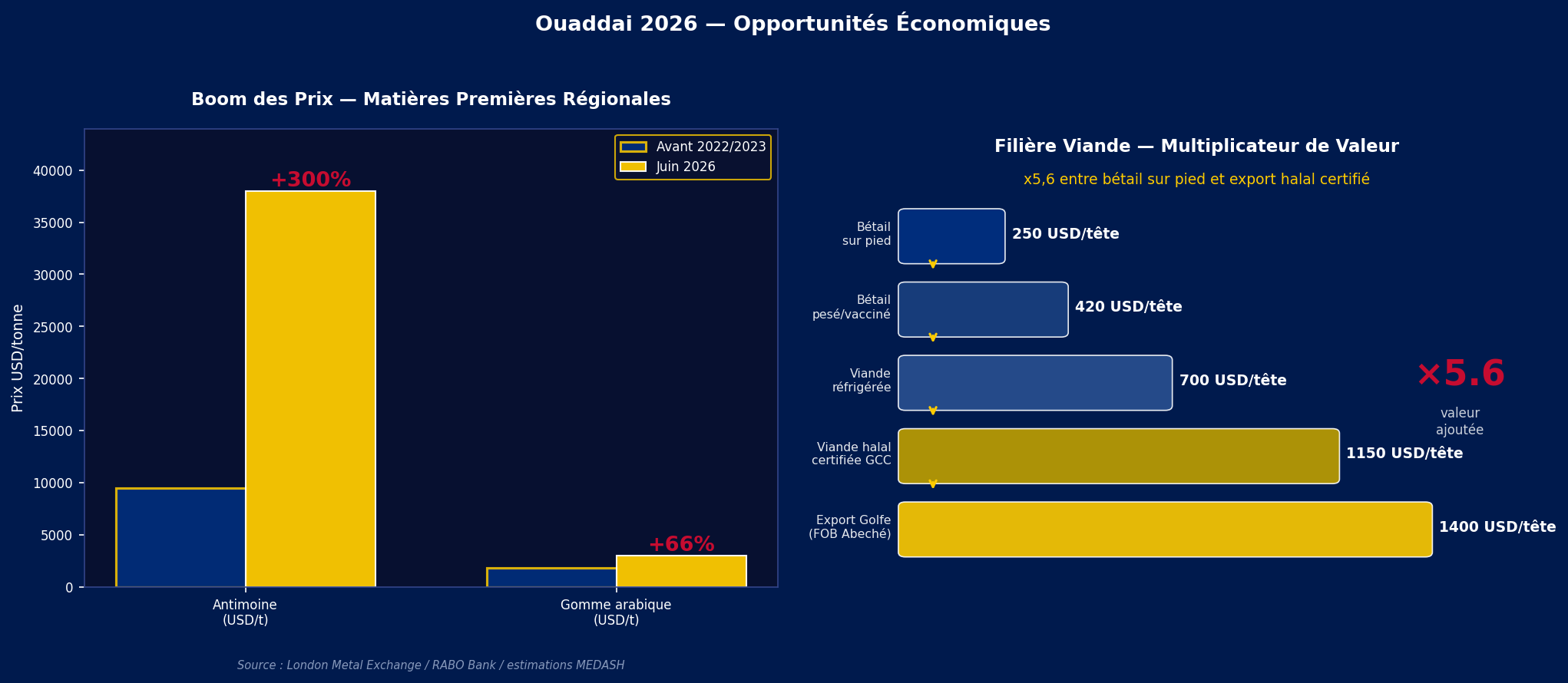
Left: price boom of antimony (+300%) and gum arabic (+67%) since 2022-2023. Right: x5.6 value multiplier for the halal meat supply chain. MEDASH illustration 2026.
3.1 Livestock: the foundational pillar (30–40% of regional GDP)
The region concentrates approximately 6 million head of livestock. The strategic breakthrough consists of moving from live animal exports ($200–350 per head) to processed and halal-certified meat exports ($800–1,400 FOB per head): a value multiplier of 3 to 4x. The Chadian government has included Abeche among its six special economic zones (SEZ) dedicated to the meat sector, with a national target of $2B and 35,000 jobs by 2035.
3.2 Agriculture and gum arabic
Women's collection cooperatives represent the most suitable organisational model for gum arabic — women are already the primary collectors — but without formal organisation, no guaranteed minimum price, and no access to campaign credit.
3.3 Cross-border trade
The Abeche-Adré-El Fasher corridor was valued at $200–400M in annual trade before the 2023 war. The reopening of this corridor is one of the most structuring events for the regional economy in the coming years.
3.4 Digital economy
With 4G deployment planned on the Abeche-N'Djamena and Abeche-Adré axes, opportunities are emerging in e-commerce, mobile payments, and an Arabic-speaking remote work hub targeting clients in the Gulf and Egypt. Ouaddai is predominantly bilingual Arabic-speaking — a unique advantage in Chad.
Economic Geopolitics and Regional Trade
4.1 The trans-African corridor
The Abeche-Amdjarass road connects Ouaddai to the trans-African Libya–Egypt–Chad corridor. This corridor is strategic for China (African Silk Road), Egypt (influence corridors towards Central Africa) and Gulf countries. Ouaddai transitions from isolated terminus to logistics pivot of a corridor spanning thousands of kilometres.
4.2 The Sudanese crisis: threat and opportunity
The Sudanese civil war is simultaneously the worst short-term threat and the best medium-term opportunity. When peace returns to Darfur, Abeche will be naturally positioned as the rear base for reconstruction: logistics, materials, training and health services, financial intermediation. The time to prepare is now.
4.3 Gulf strategic partnerships
The UAE signed 18 agreements with Chad at the launch of Chad Connexion 2030, including $700M in loans. The connection with the Gulf is not only economic: halal certification, partnerships with Islamic development institutions (IsDB, Abu Dhabi Fund), religious tourism to historical zawiyyas — under-exploited vectors that constitute differentiating competitive advantages no other African region can replicate.
Infrastructure and Connectivity
5.1 The Abeche-Amdjarass road: a major geographic breakthrough
The Abeche-Amdjarass road project (381 km, $636M, Arab Contractors, launched May 2026, estimated delivery 2028-2029) is the most transformative investment in Ouaddai since independence. Travel time will drop from 8–12 hours (impassable track during rainy season) to 3–4 hours. Commercial transport costs will fall by 40 to 60%.
5.2 Abeche airport: under-exploited potential
Abeche International Airport has a 2,400-metre paved runway capable of handling Boeing 737 cargo aircraft. Establishing a weekly cargo flight Abeche-Jeddah or Abeche-Dubai would open a direct channel for halal meat, processed gum arabic and fresh produce. The cost of extending the freight terminal is estimated at $3–5M.
Human Capital, Institutions and Governance
6.1 The education system
Adam Barka University of Abeche (UABA) is the only public university in eastern Chad for over one million people. Priority 2026-2031: creation of professional streams (logistics, veterinary technology, agri-food, IT, business Arabic) and a dual vocational training centre in alternation with companies in the Abeche SEZ.
6.2 Abeche University Hospital under extreme pressure
The only reference hospital for an 800,000 km² catchment area, the university hospital is overwhelmed by the influx of 700,000 to 900,000 Sudanese refugees since 2023. Its strengthening (surgery, maternity, radiology) is estimated at $3–5M for the urgent phase, with IsDB/Qatar Fund financing already identified.
Strategic Vision and Recommendations
Ouaddai Roadmap 2026–2031
A region is not developed by its natural resources, but by the quality of its strategic choices in the time available.
I. The Seven Truths of Ouaddai
A crossroads, not a periphery
Ouaddai sits at the intersection of three major geopolitical corridors. Its current isolation is a transitional historical state.
The real economy is already there
Cross-border trade, livestock, antimony, gum arabic: hundreds of millions of USD flow through the informal economy. The task is to formalise, transform, add value.
A time-limited opportunity window
The convergence of Chad Connexion 2030, the Amdjarass road, the price boom and Gulf demand will not repeat itself. Governance must follow within 24 months.
Human capital is the binding constraint
Not money, not even infrastructure. Without trained managers and operational institutions, no investment inflow can be sustainably managed.
The Sudanese crisis: threat AND opportunity
When peace returns to Darfur, Abeche will be the natural rear base for reconstruction. The time to prepare is now.
Islam is a strategic resource
Halal certification, IsDB partnerships, religious tourism to historical zawiyyas — differentiating competitive advantages no other African region can replicate.
The central state: indispensable partner AND principal governance risk
Regional strategy must engage N'Djamena while building local anchoring mechanisms (chambers of commerce, professional associations) that survive political transitions.
II. Five Priority Sectors
- Meat and livestock sector (2026-2028): Cold-storage slaughterhouse in Abeche (150-200 head/day, GCC halal certification, $8-12M); cold chain to the airport. Annual value at 60% capacity: $25-35M.
- Gum arabic and forest products (2026-2029): Processing unit in Abeche (3,000 t/year, $1.5-2M); women's cooperatives with pre-financing and guaranteed price; organic certification (European premium market at $4,000-5,000/t).
- Commercial corridor and logistics (2026-2031): Abeche multimodal platform (dry and refrigerated warehouses, customs transit office, mobile money, maintenance): $5-8M in PPP.
- Irrigated agriculture in the wadis (2027-2031): Collective mini-irrigated perimeters, solar pumps, improved seeds, campaign credit. Tested model from Maradi (Niger). Unit cost: $800-1,500/ha.
- Knowledge economy and services (2030-2035): Professional streams at UABA; Arabic-language digital hub targeting Gulf and Egyptian clients.
III. Roadmap 2026–2031
Objective: create the minimum conditions for productive investment.
Objective: launch industrial supply chains and consolidate the logistics corridor.
Objective: build a diversified economy capable of absorbing exogenous shocks.
IV. Success Metrics
Horizon 2027 (end of Phase 1)
Horizon 2029 (end of Phase 2)
Horizon 2031 (end of Phase 3)
V. Potential Donor Mapping
| Donor | Mandate / Speciality | Targeted Ouaddai projects |
|---|---|---|
| AfDB | Infrastructure, agriculture, private sector | Slaughterhouse, logistics platform, secondary roads |
| World Bank | Water, roads, SMEs, Sahel social protection | Irrigated wadis, SEZ SME financing, health |
| IsDB | Islamic financing, OIC member countries | Halal slaughterhouse, university hospital, technical schools, Islamic MFI |
| Abu Dhabi Fund (ADFD) | UAE loans, $700M committed to Chad | Agricultural infrastructure, solar energy, training |
| IFAD | Small farmers, cooperatives, supply chains | Gum arabic, irrigated wadis, rural women's credit |
| AFD / GIZ | Education, health, dual training, governance | UABA, alternating VET centre at SEZ, decentralisation |
| USAID | Food security, humanitarian-development nexus | Wadi agriculture, refugee transition to productivity |
| China / EXIM Bank | Large infrastructure, equipment | N'Djamena-Abeche road, energy, telecoms |
Ouaddai has known greatness. The Sultanate of Ouaddaï (1635–1912) was one of the most sophisticated states in Central Africa, controlling trans-Saharan routes, minting its own currency, forging alliances with Constantinople and Tripoli. This greatness is not a comforting myth: it is proof that this territory has the structural capacity to generate lasting institutions, networks and regional prosperity.